
Thirty participants from three Kenyan Technical and Vocational Education and Training (TVET) institutions and four Finnish trainers from Jamk School of Professional Teacher Education worked together in a one-year project from April 2024 to April 2025 to develop vocational pedagogy in Kenya. The project was implemented as a Professional Development Programme (PDP) that combined a focus on the individual with collaborative learning within the three participating institutions and between them. The PDP emphasized active and experiential learning where the Kenyan participants developed improved practices in their institutions, tested them and shared results with the others.
The final assessments demonstrated that the project was considered very useful. In this article, I am looking back to understand what the project taught the Kenyan and the Finnish participants and to reflect on the sustainability of the results in the Kenyan context.
Project context and objectives
The PDP project was part of an ongoing four-year Youth Employment and Vocational Training II initiative, which aims to improve youth employment in Kenya by integrating Dual TVET into the national system (Project description, n.d.). Dual TVET combines theoretical studies with practical workplace training, typically in equal proportions, and builds on Kenya’s Competency Based Education and Training (CBET) system introduced in 2018. The model strengthens cooperation between training institutions and industry while helping students gain skills relevant to working life (Dual TVET Guidebook, n.d.; Ministry of Education, 2025).
Funded by the Finnish and German governments and managed by GIZ (Deutsche Gesellschaft für Internationale Zusammenarbeit) in cooperation with the Kenyan Ministry of Education, other relevant Kenyan authorities and private partners, the project invited Finnish education institutions in 2023 to support Kenyan TVET development. The idea was to enable collaboration between Finnish and Kenyan TVET institutions, share the best Finnish pedagogical practices with Kenyan TVET institutions and support them in the use of modern educational technologies. Seven projects began in 2024, including the Jamk-led initiative. Partner institutions in Nairobi – Karen Technical Training Institute for the Deaf, National Polytechnic Kabete, and PC Kinyanjui – were selected by GIZ and the Ministry. Two of them launched Dual programs in 2024, while NP Kabete started its first programs in 2025.
Starting from these premises, the Jamk-led PDP project aimed to support the selected TVET institutions to develop their pedagogical competencies and practices for good quality Dual TVET. The project was planned around three main principles: First, Finnish pedagogical practices or modern technologies cannot be directly transferred to other countries. Instead, their transferability had to be explored through learning, assessment, adjustment, and adaptation to the optimal level. This required that the participating Kenyan trainers took active roles in the process. Second, and closely related to the first principle, the pedagogical process was based on experiential learning (see Kolb, 1984) where the participants practiced what they learned and learned from practice. The third principle stemmed from Finnish vocational education which places strong emphasis on competence-based learning and learner-centeredness (Tapani & Salonen, 2019). In practice, this meant that the process needed to respond to the competence development needs of each participant and institution and be flexibly adapted as understanding of those changing needs deepened. Through these principles, the aim was to support the three Kenyan TVET institutions in becoming better positioned to innovate, design and implement competence-based, and individually oriented learning processes in close cooperation with industry.
What we did – the main steps
The project was organized as a one-year professional development programme (PDP) for 10 participants from each of the three selected TVET institutions, 30 in total. Most of the participants were TVET trainers, a few had also responsibilities as Heads of Departments and some held administrative positions.
Unlike in most other projects, we did not know who our Kenyan partners would be until the implementation started. Planning a project without knowing the partners and their needs, preconditions, expectations, or ideas, clearly carried a big risk which meant we had to take some steps back before kicking off the PDP.
Thus, we started the process in February 2024 by visiting all three TVET institutions at their campuses and meeting with the management and some trainers. We discussed the main idea of the project as well as practical issues with the intention of creating joint understanding of the context, key expectations, and priorities of the participating institutions. We also initiated a needs assessment process that continued online after the visits. Each participant was asked to assess their current competence of the prioritized topics and identify individual development needs.
Based on these discussions, we set the dates for four three-day workshops in Nairobi and started preparations for the first one coming up in April 2024. Three more were to follow with the last one in April 2025. The workshops included joint days for all three TVET institutions and separate days for each institution. We also arranged online sessions between the workshops. Although not initially planned, a study trip from Kenya to Finland was also organized for ten people in January 2025. The whole process is shown below in Figure 1.
Even though the project was funded by the larger German-Finnish project, the TVET institutions invested a considerable amount of trainers’ time. Thus, it was crucial to ensure this investment paid off. In addition to the individual participants’ learning, the PDP thus carried a collective objective to develop new pedagogical practices at the three TVET institutions. To ensure benefits at institutional level, the top management of each institution was involved in all decision-making phases of the process, starting from the initial discussions and selecting the 10 participants in the program and the three people to participate in the study tour to Finland. Management representatives were also invited to the second workshop where the topics of the group development tasks were identified and the last workshop day in April 2025, when the results of all development tasks were and the overall programme were presented.
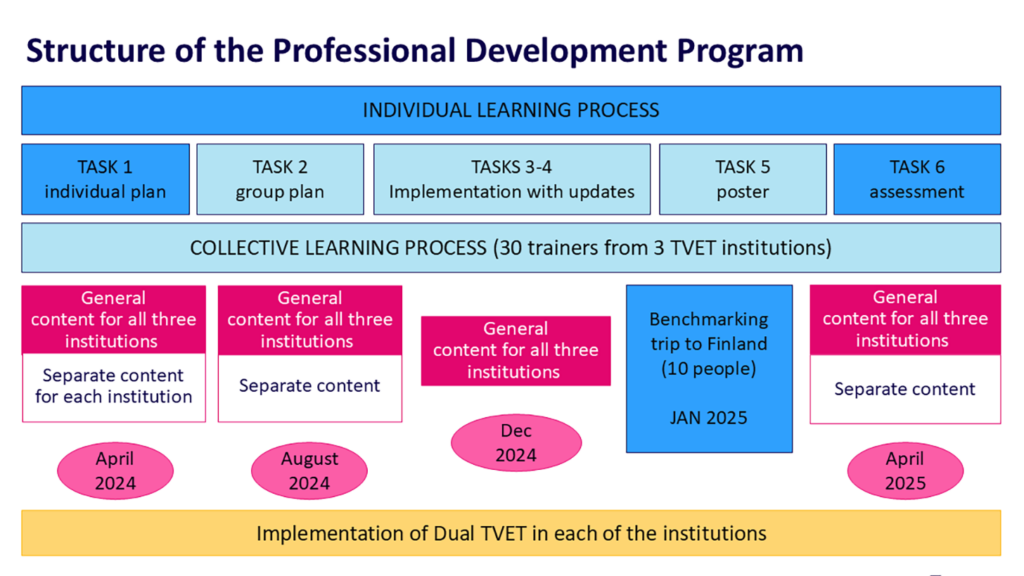
The PDP started with a focus on the individual. Each participant prepared a personal development plan (Task 1 in Figure 1) that was discussed in a bilateral online discussion between the participant and one Jamk trainer. During the last workshop, all participants met again in an individual discussion with a Jamk trainer to assess the outcomes of the program at personal level (Task 6).
After the individually oriented start of the PDP, all institutions formed 3–4 teams that selected development tasks. The aim was to focus on developing practices to support the implementation of Dual TVET in the TVET institutions. The selected topics were the following:
- Institutional policy for Dual TVET
- E-portfolios or other forms of showcasing student performance
- Project based learning
- Bringing industry to school – simulation
- Benefits to industry – study
- Research and innovation in TVET institutions
- Developing technical signs (in sign language)
The topics reflected the different realities of the three TVET institutions: NP Kabete was about to start the first Dual programs and needed internal guidelines for the implementation. In the two other institutions, some had encountered challenges in finding companies interested in the new form of TVET and wanted to study the benefits for industry in more detail. Others wanted to develop new tools such as e-portfolios that could help in going towards more student-centered learning and guiding students as they spend more time in industry. In Karen Technical Training Institute for the Deaf, there was a need to develop sign language signs for the new situation. And so on.
The process of developing and testing these tasks was part of the PDP. The teams presented their ideas, plans, and trials during the workshops and got feedback from the other participants and facilitators. In the final workshop, they shared the created methods and practices also with representatives from the TVET institutions’ management and guests from the Ministry of Education, The TVET curriculum development assessment and certification council (CDACC), GIZ, and the Finnish Embassy.
The study tour to Finland took place in January 2025. In addition to three people from each participating institution, the group included one person from the Ministry of Education and one representative from GIZ. In Jyväskylä, the group benchmarked pedagogical practices at Jamk, Gradia Vocational College, and a vocational special needs education college Spesia, both in school premises and in working life. In Helsinki, they visited the National Board of Education and attended the Educa fair, the leading event for the education and training sector in Finland.
Learning put into practice
Since the project was specifically planned as a professional development program, the focus was on supporting the 30 participants in their professional development. Even though the context was the same for everyone – introducing and implementing dual TVET – the individual needs and learning objectives varied a lot. For example, some wanted to understand more of what Dual TVET means in practice and find new ways to support students’ learning in industry, others put their focus on understanding and supporting students with various abilities to learn better, and some hoped to learn more about digital tools. For many, the areas of emphasis changed along the way.
To cater for the various needs, we as facilitators took a three-fold role. First, we shared our knowledge of best Finnish pedagogical practices in learner-centered and working life-oriented TVET and the use of digital tools in education. We also invited some Jamk colleagues and other Finnish experts to share their expertise online. Second, we facilitated sessions where the participants discussed and assessed the relevance of these practices and tools in their contexts and shared their understanding and experiences of implementing Dual TVET. Third, we guided the groups in the process of planning, developing, experimenting, and reporting the group tasks. The discussions and experience sharing between the participants from three different TVET institutions proved vital for the relevance of the process. The joint workshops with opportunities for sharing and learning from other participants were greatly appreciated by the participants.
To succeed in keeping the workshops relevant for the participants’ learning needs, we collected feedback and feedforward ideas after each workshop. This guided us in the planning of the following workshop and the process forward. Also, we collected ideas for the planning of the study tour and included sessions where everyone could learn from those who travelled to Finland.
In their report (Report in Benchmarking Mission to Finland, 2025), the study tour group summarized their key findings in seven points:
- Finland has two interlinked educational pathways, academic and vocational, they allow seamless transitions between levels and eliminate dead-end options.
- At Jamk, workplace training is highly integrated with collaboration with over 2 000 industries. Alumni play a critical role in creating opportunities.
- All visited institutions maintain strong industry collaborations that can be seen also at school-sites.
- Equal value on academic and vocational pathways: preference depends on employer needs and individual career aspirations.
- Recognition of prior learning and competencies at all levels; individual study plans.
- Special needs learners receive government-funded assistants and are trained in life skills to enhance their employability; also, preparatory education is provided.
- Education in Finland is inclusive; full support to learners with disabilities to help them achieve their career goals.
In the final discussions, the 30 participants expressed numerous learning experiences that strengthened their abilities to implement dual TVET and develop it further. It was particularly encouraging to see that many trainers had already taken a lot of that learning into their teaching practice. They had integrated digital technologies and applications in their teaching, started to use AI as support, improved collaboration with industry, and focused more on learner centered approaches, for example.
In various feedback sessions and discussions during the PDP, the participants expressed strong satisfaction with the program. They gave credits to the program structure and process, the variety of activities, the interactive and participatory methods, and the individual approach. However, there was room for improvement: some felt that the discussion was partly too theoretical, others wished more focus on digital tools. A clear disappointment for many was the fact that not everyone could participate in the benchmarking trip to Finland.
What we, as Jamk trainers, found surprising was that several participants said their roles as trainers had changed during the year. Some of them said that their experience of Jamk team’s approach to learning, including personal learning discussions, had opened their eyes and influenced their development as a trainer. Based on the final learning discussions, it seems that their confidence as facilitators of learning had grown. It also seemed that they could see the trainer’s role in the Dual TVET process more clearly than before and appreciate it, including collaboration with industry representatives.
How sustainable are the results?
The PDP process aimed to support the implementation of Dual TVET in the three institutions. Reflecting back, one of the key reasons behind the experienced success of the PDP project was that the participants’ learning was so closely integrated with the real-life challenges of introducing a new way of TVET training at the same time.
After a year since the PDP ended, the process of mainstreaming Dual TVET in the Kenyan TVET sector is still in its early phases. Despite evident benefits for both educational institutions and industries, there are challenges in fostering collaboration between institutions and companies, requiring action at the national level. (Guantai & Kariuki, 2026.) However, the pedagogical competence the thirty participants gained during the PDP is relevant for all types of TVET education that aims to equip diverse learners with working life relevant skills and includes industry attachments. At the same time, the ten trainers in each TVET institution form a progressive group of trainers who can be instrumental in developing the institution’s pedagogical practices further if given that chance.
In addition to applying the new practices in their own work, some reported that they had spread new practices to other departments and developed tools further with colleagues who had not participated in the PDP.
What about the new practices of methods developed during the PDP? Seven months after the end of our process, we met with representatives from all three institutions. They told us that the practices developed through the group tasks were still in use or developed further. Examples included arranging learning environments to simulate working life practices, applying project-based learning, and using digital tools both in class and during industry attachments. The same was testified four months later, almost a year after we ended the project, by four former participants responding to questions online. In addition to applying the new practices in their own work, some reported that they had spread new practices to other departments and developed tools further with colleagues who had not participated in the PDP. However, others noted that spreading the new practices and ideas to colleagues had not been as quick as they had thought. To ensure more impact at the institutional level, they suggested that trainers involved in trainings like this should specifically be given a chance to disseminate to colleagues within the institution. They also suggested that the PDP facilitators would spend more time at the TVET institutions and follow the proceedings more closely also after the project has ended.
At the same time, it is evident that no change depends on trainers alone. Some participants reported that using digital tools for communication with students in industry had faced challenges due to students’ limited capacity to purchase smart phones or other cachets that are needed for advanced pedagogical communication. Similarly, some still face challenges as students tend to get limited feedback from their industry mentors. As advice for a future project like this, some participants suggested more interaction with both the management of the TVET institutions and other stakeholders, especially industry representatives.
These observations are supported by previous findings on the sustainability of educational programs (see MacAusian, n.d.). While this project focused on organizational and individual levels, strong stakeholder commitment from frontline participants to leadership level was crucial. As can be seen from the discussion above, a stronger focus on developing organizational structures, processes and incentive systems to support change would have benefited long-term sustainability. However, at the individual level, sustainability was greatly enhanced by participants who were committed and possessed the right skills and attitudes to improve competences and develop practices not only for themselves but also collaboratively with colleagues, ultimately benefiting students in vocational education.
Jamk trainers learned a lot as well!
From Jamk, we were four trainers who shared the responsibility of implementing the project. Two of us started earlier with the initial visit to the Kenyan TVET institutions and two joint the team later. We took turns in travelling so that each trainer participated in 2–3 workshops. Regular meetings and joint planning for the workshops helped to keep everyone on track despite not participating in all workshops. This proved to be good practice.
Working in international contexts naturally brings a lot of new information about educational policies, contexts, and realities in other countries, in this case in Kenya. Moreover, it gives good opportunities to reflect on one’s own work and its preconditions. What is considered “normal” in the Finnish context may not be as evident elsewhere, which gives an extra incentive to think back and reconsider what we do, why and what it is worth.
Our approach to facilitation was based on the principles of competence-based learning and learner-centeredness. However, the way we started as facilitators was not what the Kenyan TVET trainers were used to. Rather, it was challenging for many participants to start with an individual competence assessment and individual goal setting. It was also somewhat confusing for the participants that we did not have a pre-fixed program for the entire year but created it along the way, responding to the emerging needs. The doubts expressed by the participants forced us to go back to our pedagogical thinking and justify our deeds by theory and research. Fortunately, the Kenyan participants were open to new experiences and decided to take on the challenge of trying out the “Finnish way”. And as described above, this turned out to be one of the key learning experiences. The year turned out to be an experiential learning process in multiple ways.
Putting the focus on the individual and designing the learning process so that it fits the needs, motivation, and learning practices of everyone is naturally a challenge – especially in a foreign context. That is why it is crucial to keep the process flexible enough so that the learners can influence their own learning experience and focus on issues most relevant for themselves. It is equally crucial that the facilitators embrace the fact that they know very little and are able – and willing – to learn all the time.